
Milton City Directory Holdings
Milton has a substantial, but not continuous, historical directory trail. The Massachusetts State Library list identifies selected Milton directory years from 1885 through 1945, plus selected voting lists through 1980. The National Archives identifies six Milton volumes near the 1930 census period. A digitized 1906 volume is the most direct starting point because it joins an alphabetical resident list to a residents-by-streets section. A missing year should be treated as a gap in a particular shelf or catalog, not proof that a household left town.
| Milton collection | Years represented | Holding location | Research access |
|---|---|---|---|
| Resident and Business Directory | 1906 | Internet Archive and catalog trail | Free digitized alphabetical and street sections |
| State Library Milton directories | Selected 1885-1945 | Massachusetts State Library | Catalog and in-library research |
| Circa-1930 directory set | 1921, 1924, 1926, 1929, 1932, 1934 | National Archives | Archive research holdings |
| Milton voting lists | Selected 1931-1980 | State Library and local archives | Historical voter presence, not ballot choices |
| Local newspaper microfilm | 1882-present across named runs | Milton Public Library | Public machine and scan-request route |
The National Archives directory holdings are useful for choosing a volume on either side of a census date. Pairing a directory with a federal schedule helps distinguish a move from a short gap in publication or a boarding arrangement.
Note: The State Library marks selected holdings in its list, so confirm the exact edition before making a special trip.
Milton Directory Years and Changes
The 1906 Resident and Business Directory of Milton calls itself the sixth volume in the Milton series and credits Boston Suburban Book Co. E. A. Jones signed the preface on May 12, 1906. That source supports the publisher for this volume, but not a claim that every later edition carried the same imprint. The earlier 1850 Dorchester and Milton business directory is a useful occupational baseline, though it is not a complete household roll.
- 1850: A Dorchester and Milton business directory provides an early business and occupation reference.
- 1885-1945: Selected Milton directory editions appear in the State Library listing.
- 1906: The digitized resident and business volume includes both name and street access.
- 1921-1934: Six Milton editions are identified in the National Archives holdings.
- 1931-1980: Selected historical voting lists add a separate local-presence layer.
The 1906 preface also says streets were soon to be numbered and that a following volume would improve the street list. That warning matters. Early Milton directory entries may give a road, a corner, “near,” “opposite,” or a neighborhood instead of a modern number. Preserve the wording first, then use an atlas, Sanborn sheet, deed description, or later directory to make a careful bridge.
Milton's 1906 directory scan is available through the Internet Archive record.

The scan gives the exact printed page context needed to read abbreviations and location clues rather than relying only on OCR text.
Reading a Milton City Directory
A Milton city directory entry is a compact record, not a present-day residence claim. In the 1906 volume, a surname comes first, followed by a given name or initial. An entry may add an occupation, an employer or work address, a residence marker, a road, and a nearby landmark. “h.” means home or residence. “bds.” means the person boarded or lodged with a named household. A Boston work address in parentheses can coexist with a Milton home line.
| Name and status | Surname, given name or initial, and sometimes Mrs. or Miss. |
|---|---|
| Work reference | Occupation, role, employer, or business address where printed. |
| Residence mark | “h.” for home or residence; “bds.” for boarding with another household. |
| Place clue | Road, avenue, cross street, section name, “near,” “opposite,” or “off.” |
| Household link | A named host can connect a boarder to a larger household record. |
- Criss-cross directory
- The street-order half of a directory, used to move from a road to listed occupants or businesses.
- Householder index
- A name arrangement that helps identify the person or household attached to an entry.
- Abbreviation key
- The printed guide that defines short forms such as Av., B., E.M., H.P., n., and opp.; read it before expanding a place name.
“B.” means Boston, while E.M. means East Milton and H.P. means Hyde Park. Dor. L.M. points to Dorchester Lower Mills. These are local and regional address clues, not errors to erase. A boarder, a work address, and a home address can describe different parts of one person's life.
Milton Directory Research at the Library
The Milton Public Library local-history collection connects directory work to the 1896 and 1905 atlases, Sanborn maps, local newspapers, MACRIS, and a Historical Society and Library archives index. The Reference Room has phone books, atlases, town reports, and old newspapers. Milton asks for an advance appointment for deep local-history work, so contact Reference before relying on a particular directory edition or microfilm reel.
The Library local-history page shows the kinds of collections that can resolve a Milton city directory address.
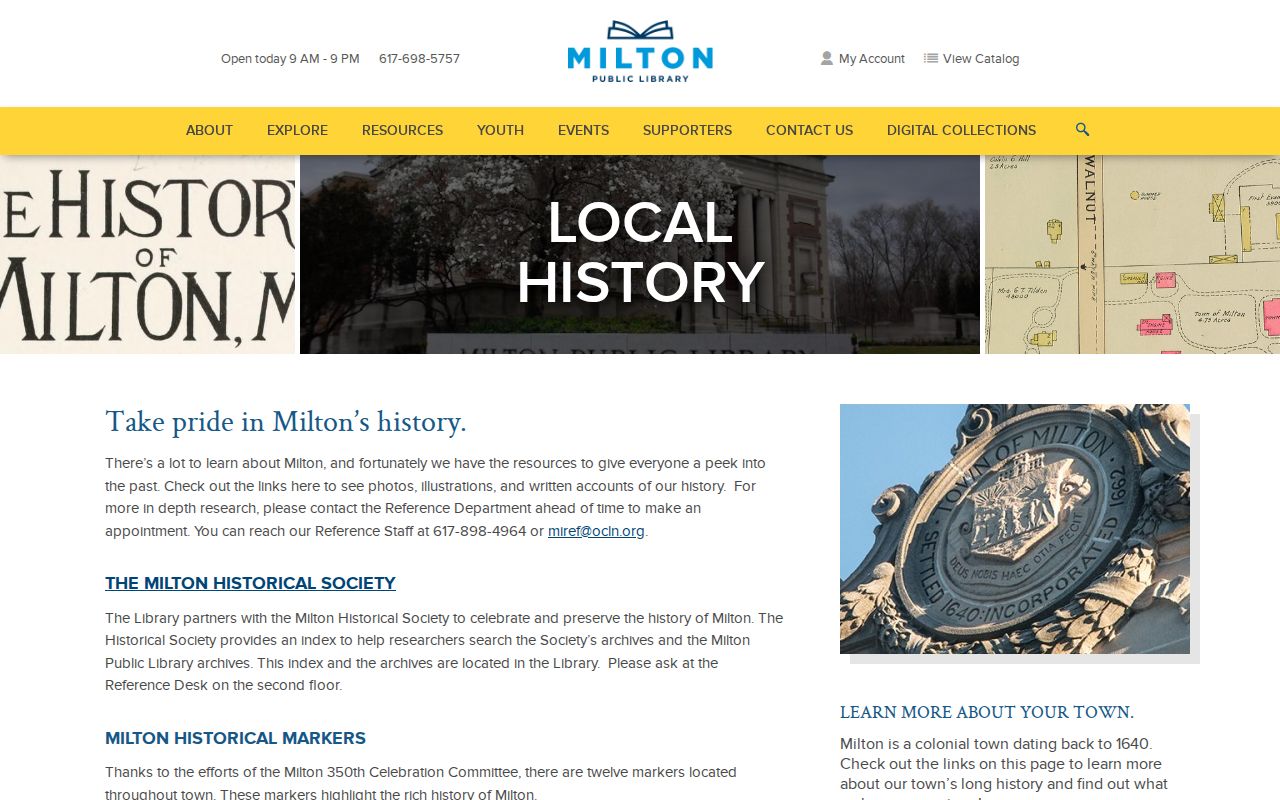
Atlases and newspaper titles are especially useful when an early entry uses a landmark rather than a numbered address.
The Library research and reference page confirms that reference staff work with the historical materials, including phone books, atlases, town reports, and old newspapers.

A reference appointment creates an offline route when a catalog record does not reveal a shelf item or the needed directory page.
Milton City Directories and Local Memory
Directories become more useful when read beside photographs, institutional records, business history, and neighborhood labels. The Milton Historical Society, established in 1904, holds material about local businesses, neighborhoods, war records, Granite Railway, chocolate, postcards, and town photographs. Its Suffolk Resolves House headquarters is at 1370 Canton Avenue. Contact the Society when a directory entry points to an old institution, employer, or section name rather than a clear parcel.
The Historical Society collections page provides a useful visual starting point for that Milton context.
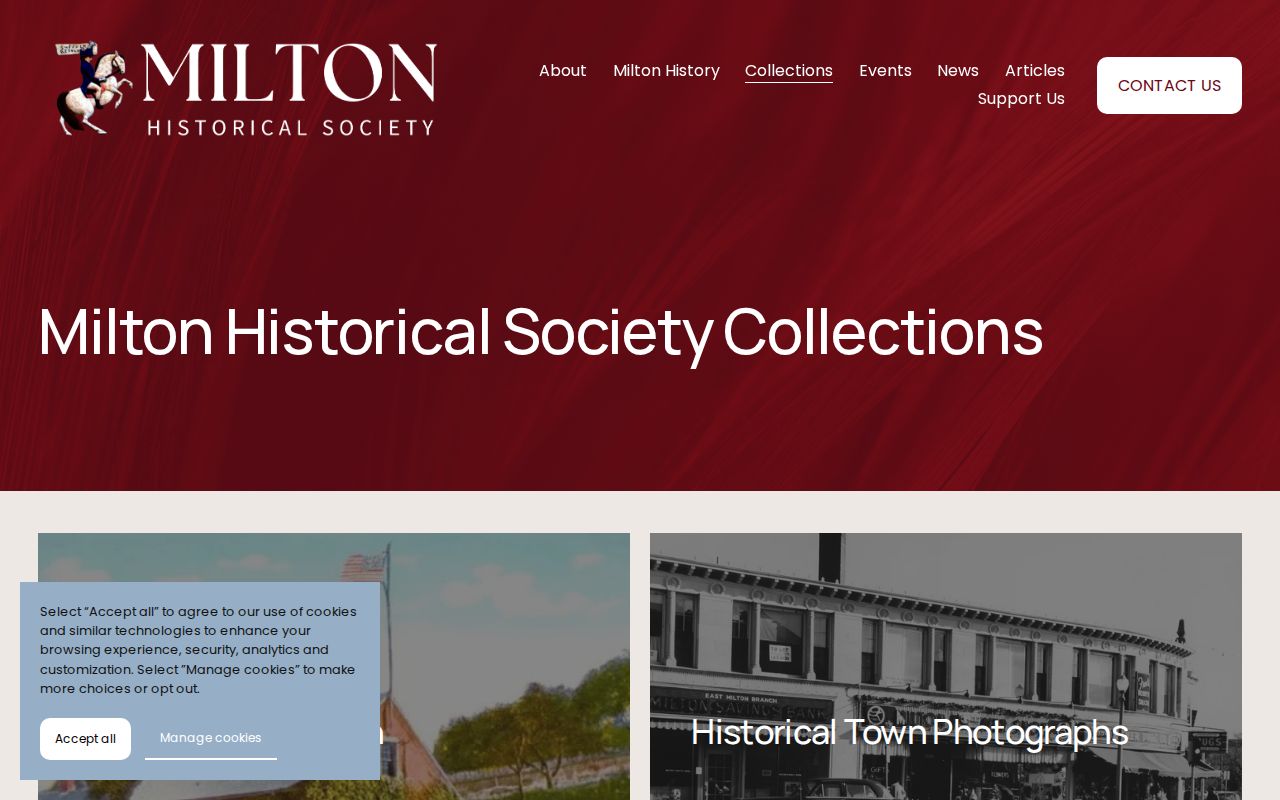
Photographs and collection descriptions can support a place identification, but they do not replace the wording in the directory or land record.
The Historical Society online archive includes dated nineteenth- and twentieth-century objects, photographs, and albums.
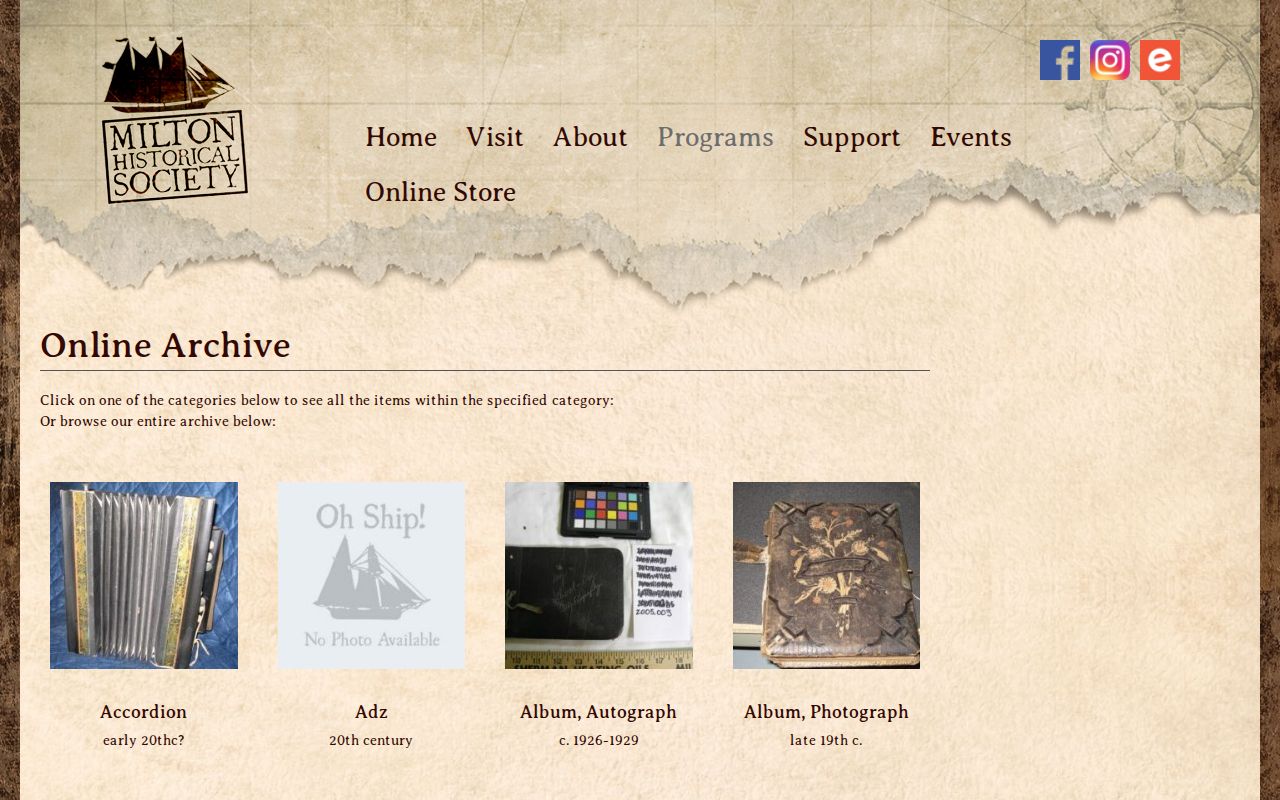
Those date labels help test whether a directory address belongs to the same Milton institution or neighborhood in a given period.
Milton Directory Gaps and Cross-Checks
Milton Library newspaper microfilm supplies the bridge between directory years: Milton News runs from 1882 to 1904, Milton Record from 1904 to 1953, Milton Record-Transcript from 1954 to 2012, and Milton Times from December 1995 to the present. Obituaries, marriage notices, real-estate advertisements, probate notices, and local-business mentions can narrow a move or explain why a name no longer appears. The Library can manually search microfilm and email scans to non-residents under its documented genealogy service.
The Milton Public Library genealogy-research page describes its microfilm, cemetery records, public machine, and scanned-page request route.
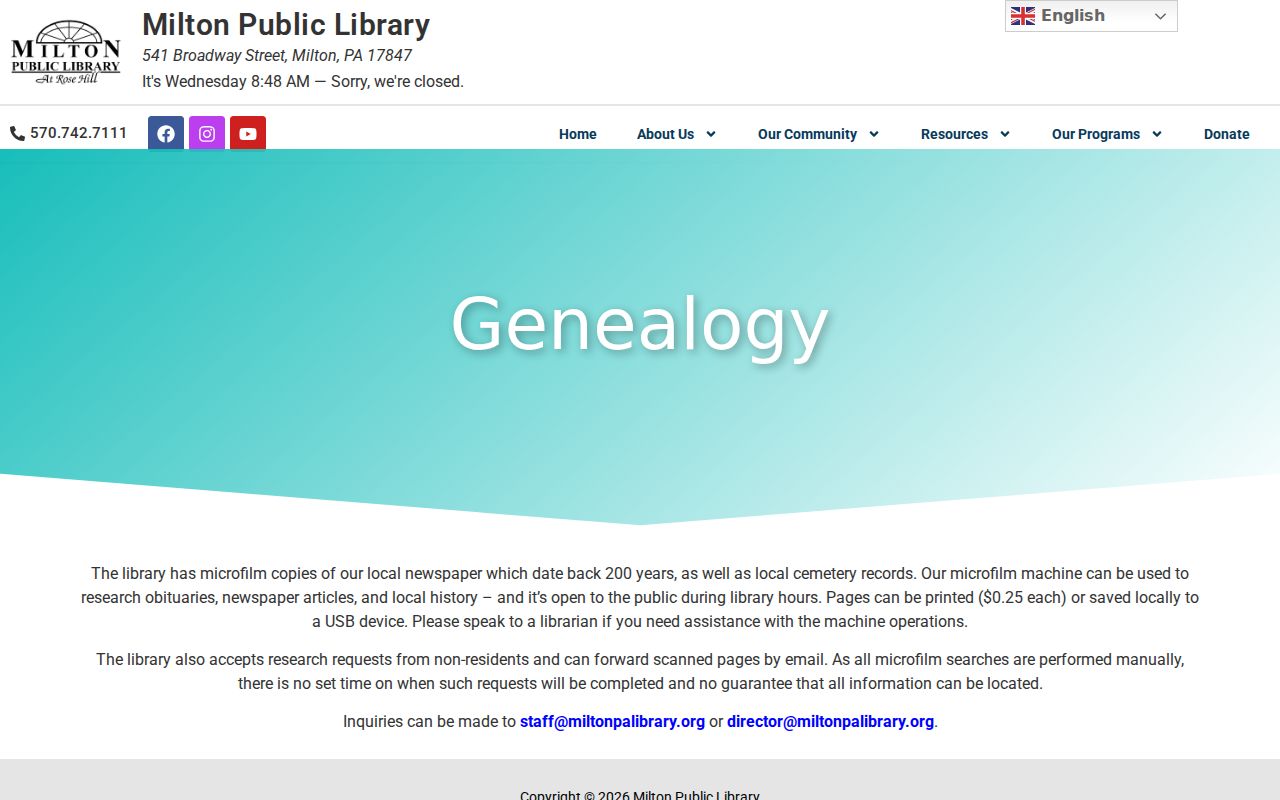
Newspaper and cemetery evidence can test a directory transition without turning an unverified absence into a conclusion.
Sanborn material supplies a separate physical-place check. Milton Library lists runs from 1901 through 1949, and the Library of Congress confirms a 20-image 1923 Milton set that includes East Milton and Milton Centre. A map may show a building's outline, use, size, or shape, while the directory supplies people and the year.
Note: A neighborhood label such as Railway Village or Milton Village may be a historical place clue, not a modern postal address.
Milton City Directories on Historic Maps
Milton city directories and historic maps answer different parts of the same address question. The 1896 and 1905 Milton atlases, the 1906 directory map, and the 1901-1949 Sanborn material can establish whether a road, lot, or building was present before a later numbered entry appears. The Library of Congress confirms a 1923 Milton Sanborn set with 20 images, including East Milton and Milton Centre. A Sanborn sheet can show building outline, size, construction, and use. It does not identify everyone who lived there.
Milton's historic geography matters here. Railway Village grew near the Granite Railway crossing at Adams Street and Granite Avenue. Milton Village and Lower Mills reflect the Neponset River industrial corridor, while Milton Hill, Brush Hill, Scott's Woods, and Milton Centre can appear as section clues. A directory line may use one of these names where a current assessor search expects a street number. Preserve the historical label, then compare the year and map before normalizing it.
Town historic-property surveys and MACRIS references provide another layer of architectural context for a property. Pair that context with a deed chain or directory entry. Neither a map nor a survey alone proves a household identity.
Tracing Milton City Directory Households
Use the Milton city directories as a sequence, not as isolated name hits. Start with the person index in one edition, then find the same street in its residents-by-streets section. Record the spelling, occupation, employer, residence wording, household host or spouse notation, and any nearby landmark. Repeat in the adjacent available edition. The goal is to preserve changes in the record rather than force each entry into a modern address too early.
- Record the first Milton directory appearance and every detail printed with the name.
- Read the street section from that same volume and note nearby listed households.
- Compare the next available directory year for a changed surname, employer, widow notation, boarder status, or address.
- Pair editions near 1900 through 1980 with the corresponding released federal census schedule, subject to the 72-year rule.
- Use a deed, assessor record, obituary, cemetery record, or probate file to separate owner, occupant, heir, and final address.
A disappearance can mean a move, death, temporary absence, a new spelling, or non-inclusion. Newspaper notices and probate papers can help close the trail. When the question shifts to current parcel evidence, use the Milton street-address directory for the modern address-led chain. When a historical find needs a current identity check, use a narrowly sourced Milton resident lookup rather than assuming the directory record remains current.